
Summer 2025

Updated: Jan 25
End-May to mid-September, 2025.
The Vagabonds return to the United States to see friends, family and physicians.
We spend the first ten days reacquainting with our Massachusetts family and grandchildren. It has been 18 months since we were together.


They have just adopted a new puppy, Harry, a black labradoodle. He is lumbering and cute, with a puppy’s need to chew, so one has to watch getting your hands too close to his mouth.

Soon, though, it is time for a three-week road trip. First stop is Ohio. Mary heads to see her family in Cleveland, while Rick goes to Columbus to attend his high school reunion – 55 years from the day of graduation. Attendance is good, about two-thirds of the living classmates. There is much conversation and catching up in the general way that folks who were once connected but now only occasionally see each other do. What strikes me though is the shared values and kindness of almost everyone. Being reared in the same / similar location, social strata, and cultural environment is telling and lasting.
And, of course, we also take the opportunity to catch up with our good friends and family in the area.

Then we drive south. We stay for a few days in Tennessee visiting with our sister-in-law, nephew and niece. Going further south, we also spend a few days in Georgia with our lovely daughter, and with our good friend Matt.
Florida is our next port-of-call seeing friends in Sarasota who are preparing for a dance competition.


While we are there, as it happens, our nephew and niece from Tennessee arrive with their son and grandchild for a long weekend at the beach. Our recently retired friend, Amy, comes up from Ponte Gorda too, so there is a party!

From there we stop in Charleston, South Carolina to sight-see. We join a walking tour of the city with a chatty, articulate fellow in his forties who speaks with the cadence of a professor. He knows a lot about Charleston and provides perspective about its role in the Southern economy and culture.


Next is a brief visit to Washington, DC. where it is blistering hot. We stop at the US Achieves to see the Declaration of Independence, Constitution, and Bill of Rights, and the Smithsonian Museum of American History.

We also walk around the Washington Monument, the WWII Memorial, the Vietnam War Memorial, a new statue honoring the nurses who served in Vietnam, the White House and the US Capitol building.


From there it is a long day’s drive back to Massachusetts. We start a pet-sit about 20 minutes northeast of where our family lives so that we can see them frequently. We stay in a farm house originally built in 1640 with two acres of land in the back. The kids can play baseball in the back yard, there is a hot tub, and there is a homemade ice cream store just down the street. Our pet is a huge, shy cat who lives in the basement and only comes out to feed when we are asleep or out.


This pet-sit lets us resume a somewhat normal lifestyle. We can cook, work down our library wine inventory (it’s nice to have Californian wines again), attend to medical needs, catch up on administrative duties, and golf. Since we are in New England, we can easily find good oysters and other seafood.
We are able to participate in some of the kids summer events too. They are busy all summer at various camps (e.g. basketball, fishing, book, tumbling, theatre). We attend Maggie’s production at the end of theatre camp, and several of her and Jack’s baseball games.

By ourselves, we attend a production of Love’s Labours Lost under a tent in the town of Rockport along the seacoast northeast of here. It was preceded by a bring-your-own picnic. A well-done, fun summer fare.
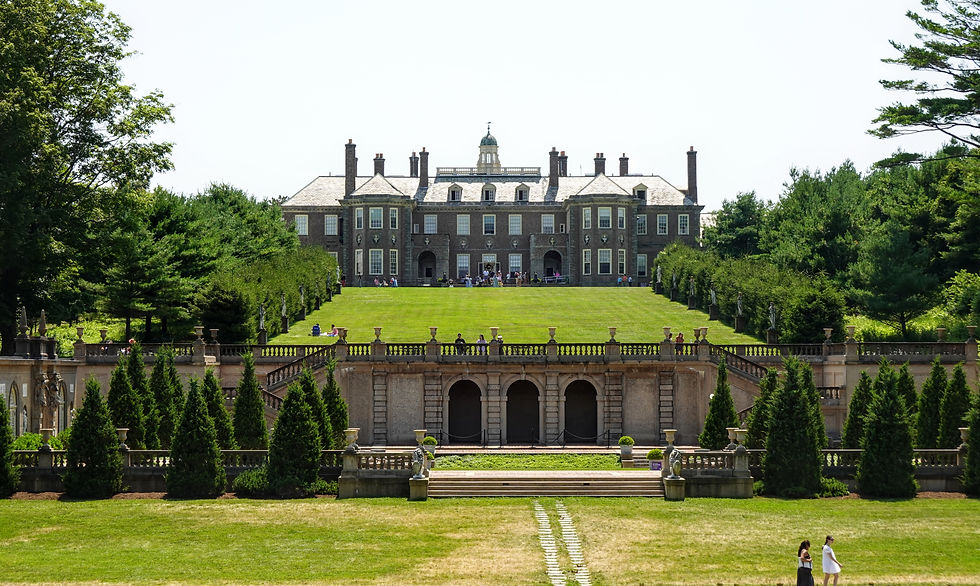
We also tour the Crane Estate near the towns of Ipswich and Cape Ann. It includes a large beach, Castle Hill - a 59 room mansion built in 1928, and gardens. The property has a long history dating back to 1634 when English settlers arrived. The current mansion was built by Richard T. Crane Jr as a summer home. He owned the Crane Co, a very successful plumbing supply business in Chicago, and was an avid sailor. At its height, the estate encompassed 3,500 acres, and Castle Hill hosted many illustrious guests. The mansion was especially known for its elaborate, art deco bathrooms – befitting a plumbing millionaire. Tours of the mansion are house are led by a “maid” or “butler” brimming with tidbits on family history and the eclectic décor.
Each person in the tour is assigned a role as a “Guest of the Cranes”.
We also attend the town of Beverly’s Homecoming which features various events like a lobster roll night, and live bands playing in the park along the sea coast.

Attending to medical matters is a big focus of the summer as Rick attempts to gain a handle on his lung condition. Our new Boston-based physician is a specialist in our particular lung issue. She did her homework in digesting all of the information we provided from our Portuguese doctor, and spends a lot of time discussing our questions and concerns. Then she orders a battery of tests: extensive blood work, another CT scan, and an Echo cardiogram in order to obtain more data. These take a month to complete. Based on the results the doctor recommends a biopsy procedure to help determine the extent of inflammation and other abnormalities in the lungs.
The biopsy indicates that Rick has fibrotic hypersensitivity pneumonitis.
The literature defines this as: a chronic and often progressive form of interstitial lung disease (ILD) characterized by inflammation and irreversible scarring (fibrosis) in the lungs. It is caused by an exaggerated immune response in the lungs to repeated exposure to inhaled substances (antigens). Over 300 causal antigens have been identified, but none are obvious exposure points for Rick, which is also true for some 60% of other patients.
The decision for treatment is to wait and watch since the inflammation seems to have mildly improved over the summer. This seems preferable to the alternative of starting a regimen of drugs that may not work and usually have unpleasant side-effects. We will continue tests and monitoring to verify that the condition stabilizes.
Meanwhile, the vagabonds start another pet-sit – for two dogs – in Roslindale, a south Boston neighborhood. It is an urban area but much less “city” than Boston proper. Street parking is plentiful and there are a few blocks of central shops that give it a small town feel.
The owners, Alexa and Roger, take us with them to a meet-and-greet fund raiser for Boston’s mayor, Michelle Wu held at a neighbor’s house a few blocks away. Mayor Wu also lives in Roslindale and so has a base of support here. There are perhaps 250 people in attendance in the large lawn space. The atmosphere and dress is very casual. After 90 minutes or so, the Mayor arrives gives a 15 minute talk then answers questions from the audience. She is articulate and fact-based about the things her administration has done over the last 3 ½ years in office. She avoids any critical comments about prior administrations or what she inherited from them. And so she presents herself as intelligent, informed, caring, and likable. She also has her 7 month old baby daughter with her which helps with the “I’m just a neighbor” image. She should learn to make her points more succinctly, however.

The Mayor has an interesting history. Her parents immigrated to Chicago from Tiawan and spoke no English. She is an accomplished pianist, attended Harvard University, worked for a short time at Boston Consulting then abruptly returned to Chicago to care for her mother who became ill, and her younger siblings. She then moved her mother and siblings to Boston so that she could attended law school at Harvard. Afterward, she became involved in politics and got herself elected to City Council. In 2021 she ran and was elected Mayor at age 36. She says that she views Boston as a collection of neighborhoods with different needs and personalities.
It is a bit of Twilight Zone to be in this gathering of very liberal people. There is a group-think that is pervasive: Republicans are bad. The Trump administration is dangerous and threatening. Rich (“billionaires!”) are by definition the enemy. Progressive agenda is good (e.g. climate change is caused by fossil fuels; the rich prey on the poor; we enlightened must act to protect the unenlightened; regulation and the power of government is the tool to guide social change; nonprofits are good; etc).
Next, the vagabonds drive to Jamaica, Vermont to visit our friends John and Terry. It is a time of chatting and catching up; playing Rummykube; walking their dogs – Kirby and Kacey; cooking and dining. Low key. We also play a round of golf at Stratton the local course where we were members for the two summers we spent living here.
From there we drive south to the Berkshire region of far western Massachusetts. The area is affluent with many large, and sometimes older, houses set on large swaths of land among the rolling, forested mountains / hills. We tour nearby Chestwood House and Studio. It was the summer home of Daniel Chester French from 1897 to his death in 1931. In his day, French was the foremost sculptor of public statues in the country. His works include: The Lincoln Memorial (1922); The Minute Man (1875 at Concord MA); the Four Continents (1907 at the US Customs House, Manhattan); and dozens of others throughout the United States.

The house and studio contain the original furniture and features that existed when the family lived here. The forested grounds are crisscrossed with trails holding modern sculptures and ancient trees (many 200 – 250 years old) with red, blue or yellow wraps to distinguish them. One can sense the restfulness of the place.
We also visit the Norman Rockwell Museum. Rockwell grew up in the New York area, later moved to Vermont, and in his later years lived in the Berkshires. He got his first art commissions while still a teenager, and by 1916, at the age of 22, he painted his first of over 300 covers for The Saturday Evening Post, becoming the quintessential illustrator of American life.

Rockwell’s covers were created from large (e.g. 3’ x 2’ or more) oil paintings which were very detailed and careful to capture the effects of light on his subjects. This level of detail wasn’t necessary for magazine covers (where much of the color and backgrounds were lost in the printing process) but was included by the perfectionist painter for realism. The museum displays dozens of Rockwell’s original paintings, including all of the Post covers that he created. It is an inspiring collection.
Driving a bit north we arrive at Williamstown, a small college town where we start a week’s pet-sit. The dog, Gunner, is one of the better beasts we have watched; he is smart, obedient, and pays attention to us – always looking around to assure that we are with him. He is good on his leash, and ignores other dogs. A good companion (except for his shedding).
We find a golf course in good condition at Waukeeba Links, go to the new Downton Abbey movie, and attend a dandy fine arts museum called The Clark which has a lovely collection of impressionists as well as artist from the 1500’s to 1700’s with 10,000 paintings, sculptures and other works of art on display.
The vagabonds return to Boston to spend a few more weeks with the kids and get reacquainted with Harry who seems to grow by 10 pounds each time we see him.

We arrive just in time to see Jack’s first Flag Football game! He only has 5 players on his team (the opposition has 8 or 10) but that allows all of them to get a lot of playing time. They win the game even though they are considered the weaker side. Congratulations.

It is also fall baseball season. Maggie’s baseball team uniforms are bright pink and the girls relish the style. They play through 3 innings, each player bating until he or she gets a hit. Maggie’s swing is level; when she gets her timing down she will be formidable.

Jack plays catcher for his team and does an impressive job given the pretty wild throws of the pitchers. Jack gets two walks (good eye!) and is a heads-up base runner; he scores two runs. The teams play very well (except for pitching) especially realizing they are 9 and 10 year olds!
Jeremy has an adult league softball team. He is perhaps the best player on the team, plays third base, and makes several heads-up plays including knocking down a line drive and crawling on his knees to second base to tag out the lead runner. Jack is highly engaged with the game, cheering on his Dad and calling balls-and-strikes for the umpire.
The players are hungry after their workouts. Jack specifically requested Grandpa Rick’s steak – medium rare. He says it is favorite dish, and he can eat three servings of it at a meal. Dinner is capped with a Mary-made cake with blueberries and peaches. We also celebrate Laura’s birthday!

We are especially glad to be here to see Jack and Maggie off on their first day of the new school year; Jack is now in 4th grade, Maggie in 1st. There is great excitement: some new school clothes; the Malley tradition of a photo of each child holding a chalk board announcing their new grade and their expectations for the new school year; the gathering of the neighborhood children and parents for the walk together to the school two blocks away; balloons at the school entrance; smiling, happy people.
Too soon it is time to return to Portugal for the winter.


Comments